Showing posts with label Mark Jones. Show all posts

Saturday, 23 September 2017

Day Two of the Plymouth Arts Weekender 2017: Town and Millbay

Today did not disappoint in the quantity of stuff I managed to cram into 7 hours, and I'm sure my pedometer is sitting in the five digits region I've done so much walking. But it feels good to be engaging with this city in such a rewarding way. I hope I have done these installations even half the justice they deserve.

NB: as this article was written in collaboration with Plymouth University's SU: Media online magazine, some editing has been done which I have applied (in places).

As I very much predicted, having set out today with a plan of what I wanted to see and when...nothing really permitted me to follow said plan.
The time was half past nine and I arrived into town to view Temenos, an installation at the Methodist Church Central Hall. The installation revolved around the idea of thresholds, sanctuaries, and new things coming into being, only to find the opening time had changed. Afterwards, I was on a mission to find the Orbit Bus Session but this was unfortunately delayed. I came to realise that is was possible to be too organised.
Fortunately, I was now able to return to the former sanctuary of Ric Stott and Ian Adams. Through a series of 10 paintings (Stott) and poems (Adams), a viewer was taken on their own journey of self-discovery, the former balancing warm swathes of colour with cool scribbles and scratches over beautifully simplistic black and white drawings, which the latter gave greater spiritual meaning to. By the end, only warmth and strength remained, as if ready to start the ‘story’ over, an apt method given its religious vibe.
The Truth Wall - Plymouth What's On stand
Following this, I thought I would be at a loss once more until The Truth Wall began shouting its anti-politics at me from the "What’s On" stand. Organised by the Kiss and Bite Letterpress Studio, any potential traces of old announcements were virtually smothered by the haphazard pasting of 80s-style propaganda. Its boldly coloured declarations of ‘Don’t Be Calm, Be Angry’ were instantly eye-catching and subvert the typical 'Keep Calm and Carry On' narrative. After circling this outspoken piece a few times like an inquisitive dog, I wandered to the Hoe in search of Anita Lander; her unique decision to sit and listen on a bench beneath a tree for seven hours intrigued me. Alas, she too was nowhere to be seen so I turned myself back to town to continue the next leg of my arty odyssey.
Having sufficiently caffeinated myself with an iced Americano and picked up my constant companion in all things arty, Mark Jones, we investigated BankRUN, a small wooden ATM created by Lara Luna Bartley to mark the 10th anniversary of Northern Rock’s collapse. Having ‘activated’ the machine by trusting my finger to a small hole in the display, a magical hand provided me with the option of three bank notations and one of three radical economists to adorn the note. After a brief wait, the chosen note was delicately ejected through a slot, bearing Ben Dyson’s face on one side, and a female face oddly like my own on the other. Wishing it had any monetary value, we advanced to the bus stop in anticipation of the Wonderzoo Bus Tour organised by Peter Davey. Just up the road sat the number 34 Orbit bus, its top deck stuffed with brilliant pink orbs, taunting my impatience and self-inflicted schedule, but I had stranger things to attend to on a bus. Joined by some of last night’s Versify crew, we experienced out-of-tune group renditions of The Sound of Music. Oddly enough, West country comedian Richard James appeared to be more at home shouting at people on a bus (despite the unconventionality of doing just that) than small talk. Versify’s own poet, Nick Ingram, was looking to beat his own record for the verbal 100-metre dash, before Versify’s organiser Marian tantalised the ears with her poem on whales, whales, whales. After an hour, we’d ended up so far out of town, we needed to catch another bus back.
Once returned to familiar ground, we trekked out to what I perceived to be the final location on my schedule, the Plymouth School of Creative Arts, playing host to multiple installations for the weekender, which included:
The Curious Cattewater Dog Cabinet (Zoe and Callum Moscrip): a means of bridging the gap between artefact and community by bringing evidence of one such artefact (a shipwreck) to life in the form of a skeletal puppet dog. Despite its obviously deceased state, I felt it might move at any moment – if only the mechanism would allow it to.
In the Air… (Jenny Mellings): a set of three aerial painted scenes of remote landscapes – even as far as Saturn’s moon, Titan – which provided a way to make the distant seem nearer, and the reverse, in a tangible space.
What do you see? (Janine Rook): a series of visitor-created Rorschach inkblots intended to explore one’s psyche. Most of the images had a biological nature for me – lungs, tree, uterus – what could that be saying about my psyche?
Paradice Lost (Stuart Robinson and Kirsty Harris): in my quest for deeper meanings behind art, this minimalist interaction of a neon red sign saying ‘PARADICE’ (Robinson) and a colour scene of a mushroom cloud (Harris) said it all loud and clear. However, that was not all there was to it. Other interpretations emerged from my conversation with Stuart, such as the installation’s sense of not-rightness. This derived from the incorrect spelling of paradise and the innocuous ‘poof’ of the cloud.  It was through this conversation that my [true] final stop was mentioned: KARST’s contribution to We the People Are the Work, I Am Your Voice by Claire Fontaine.
In the spaces provided, we found a map of the British Isles composed of burnt matches, signifying a ‘tragedy perceived too late’, the smell of which tainted the air; and a set of three neon signs in red and white lighting up an otherwise pitch-black room which smelt of fresh paint. Their ambiguous messages allowed a viewer to question the concept of morals: I do it because it’s right/It’s right because I do it. 
An ominous self-portrait
The signs frighteningly seemed to communicate with one another as the individual words lit up, making me glad to leave the room – if only to peep into KARST’s own Peepshow. Through nine installed peepholes could be seen a snippet of the resident artists’ work, allowing the average viewer a glimpse behind the scenes, one piece proving difficult to tear Mark away from due to it living up to the installation’s name.
Phew, and with that, day two is wrapped. Any quotes are taken from the provided leaflets. Bring on day three!


Friday, 22 September 2017

Day One of the Plymouth Arts Weekender 2017: Various Areas

So here we are again, PAW round two. So far it's been a wet but still fulfilling day and I can only expect more to come. Someone help me, what have I done? But in all seriousness, I am writing this review for the university's online magazine so I must make the effort, plus I like working to deadlines. So enjoy.
NB: as this article was written in collaboration with Plymouth University's SU:Media online magazine, some editing has been done which I have applied (in places).

It’s getting late as the first day of the Plymouth Arts Weekender 2017 draws to a damp close, but the challenge of documenting this city-wide event still lays before me, and so, in true student fashion, I shall be awake long after my accustomed bedtime (and probably for the next two nights also).
I was reasonably well rested but was very eager to seek out the artistic talent that was on offer in the Scott Building on campus. My main goal was to locate on the top floor a small exhibition of MA Photography called Perception. Slowly tracing my way down the silent corridor, I gave each piece my full attention and found my favourites to be thus:
She is Whispering, They are Whispering
 Mary Pearson – She is Whispering, They are Whispering: an almost 3-dimensional diptych of misty trees which felt as if they were hiding their aforementioned whisperer(s) in the gloom.
Cheryl Davies – The Seven Seals: a contrasting pair of white on black Spirograph-effect forms, one orderly, one chaotic, but both equally discomforting in their respective states.
Christopher J. Russell – My friend, you are a lunar lamplight: in five night-time shots and a brief travel narrative, the streets at night are brought alive despite their apparent barrenness, everything the light shines on brought into sharp focus.
Donna Richardson – The River Flows; and Mathilda Hu – It’s difficult to be water: water can be a difficult form to capture, but both Richardson and Hu managed to depict their subject uniquely and clearly. 'The River Flows' provided a snapshot of life, especially vivid when seen through a lightbox, the motion of the water’s texture anticipated but never realised. However, with 'It's difficult to be water', this texture was played with, first scaly and cold, then soft, through to warm and golden.
Sue Taylor-Money – Leaving by Degrees: a particularly poignant piece told through photo and poem of an ageing man contemplating life, exuding a kind of sad strength which touched me, as I imagine it would have done others.
After a little disappointment from two exhibits nearby – and a few hours spent manning the Peninsula Arts stall during Freshers Fair (my thanks to everyone who came and listened) – I wandered my way through the rain to the Safe House. This was an installation whose location was only disclosable via email, but which revealed itself to be a small semi-interactive sound-and-vision immersion within St Peter’s Church. 
I was greeted by the artist herself (who shall remain anonymous), who, in keeping with the installation’s domestic theme, provided me with a mug of tea before explaining the story behind what I was seeing/hearing. Each of the four projected videos within the small chamber illustrated her feelings concerning domestic abuse, something she has been a victim of herself: a cloth doll being gradually unpicked; the suicidal or forced proximity to a cliff edge; the playful yet uneasy fall of feathers as if from a pillow fight; and the small beams of light/hope from a net curtain. Wrapped up in a paranoid-schizophrenic chatter, its entrance was strewn with broken eggshells – which I was encouraged to walk on – and it was impossible not to feel uneasy myself; the church, a usually safe place, only amplified the voices. But Karen, by providing me with the background information and becoming my living placard, seemed to soften the chaos, further illustrated by the happier, silent video which sat on a separate set nearby.
Still smiling, as I walked back into town through the rain, my penultimate stop was I am not a robot at the Radiant Gallery on Derry’s Cross. Set up to raise awareness of foster care, the small dimly lit space was haunting, hung with tangled webs of fabric and multiple silver and white cages, each home to a furless, metallic, sleeping Furby. These would periodically wake up with a subtle click of their plastic ears and beaks, half-lidded eyes blazing bright. The atmosphere was enhanced by a sci-fi soundtrack which was equal parts hopeful, yet haunting. These metallic ‘children’, representative of real ones, were intended as foster child analogues to test one’s fostering skills, but the moment I saw Tim Burton’s poetry sitting on the provided sofa, I was only worried I’d make the poor things cry.
Thus, with a rotisserie chicken Subway in hand, I finished the day with an evening of words and sound at Versify, the culmination of a month of creative workshops at Union Corner. Having spent the better part of an hour simultaneously finishing a half-written poem about an overzealous poet and listening to those on the night’s set-list practise their material, we were ready to begin. Amongst the talent was a spot of exotic dancing, some short but infectious rapping, young singers testing their vocal chords on punk and rock, an even younger dance prodigy who moved like a robot marionette, and a sizable dose of modern day comedic poetry, most notably (and deafeningly) delivered by the established poet Nick Ingram - a man I would describe as the ‘clown’ of the Plymouth poetry scene. When it came to test out my new material, I was genuinely surprised at my own nerves, but also at the post-delivery high I had forgotten came with these gigs – not to mention the occasional enthusiastic compliments. My good friend Mark Jones followed in my wake with his own breed of brief and bizarre wit, before the night began to wind down and put an end to day one of PAW17.


Sunday, 11 June 2017

Review of A Clockwork Orange (performed by The Actor's Wheel) at the Barbican Theatre, Plymouth, June 10th, 2017

The moment the lights went up on this show last night, I said to my friend Mark 'I will not be able to write a review for this; I simply will not do it justice'. To prove myself wrong, here is the review I said I could not do. It was simply a genius piece of acting from all involved that I felt could not go unmentioned.


I may not know how to start a review in a way which does justice to its subject, but when deciding how to open this adaptation of Anthony Burgess’s A Clockwork Orange, director Kevin Johnson has hit the nail squarely on the head.
From out of the darkness comes a chorus of the versatile and pervasive question ‘What’s it going to be then, eh?’ which returns countless times throughout to remind a viewer of the power of every choice the main character, Alex, makes. This opening is haunting, not just audibly through its canonical repetition, but through the use of light – another device which is used to spectacular effect throughout – which mimics Queen’s ‘Bohemian Rhapsody’. At first, I feared this performance may be too heavily reliant on song, turning Burgess’s masterpiece into a modern-day Sweeney Todd, but as the initial dance sequence wanes, the old recognisable moloko bar comes into focus, and our ‘humble narrator’ steps forward to begin his tale. What follows is an inventively choreographed amalgam of ballet, street dance, traditional theatre, and a mind-blowing utilisation of the stage.

Much like at Stratford-upon-Avon’s RSC Theatre, moveable boxes are employed to mimic walls, beds, and benches, but The Actor’s Wheel take this technique to another level. These boxes become cars, with the addition of ‘street-lights’ and ‘bridges’ (handheld torches and boxes) being passed overhead; they become plinths on which items stand to signify different locations, from the minimalist home of Professor Alexander and his wife, to the rich glamour of the Cat Lady’s abode. But most remarkably of all, they are climbed over and through and around, carried and slept in by Alex as he is stripped and examined and subjected to the processes of life in prison and the correctional facility. And where boxes will not suffice, the cast become props themselves, moving Alex through the space with often complex manoeuvres. Picture frames also play a significant role, illustrating the media presence, as scenes are often visibly ‘framed’ to be reported or printed for mass consumption, or the authorial presence, as Alex is ‘framed’ for his crime, the picture frame transformed into a set of handcuffs.

Yet, none of this would’ve been quite as affecting, firstly, without the contrasting medley of classical music and ‘grime’ (to quote Kevin Johnson) which gives each scene its character and provides the soundtrack to Alex’s life. Certain actions and scenes indeed benefit from and work with the music to give them added power, so that every punch, kick, and sexual thrust becomes a violent work of art, occasionally dealt in slow motion in homage to Stanley Kubrik’s film adaptation. This marriage of sound and vision all leads to the final scene of the first half. Already frightening as a tableau of illuminated cables raying out from a restrained Alex, screaming and gagging with his eyes held wide open, this scene strikes the nerves still further thanks to the strength of the orchestral music used in his torturous conditioning.

Central to this, of course, is Ashton Corbin, who has fully immersed himself in the character of Alex. The necessary depiction of his suffering affected me deeply due to its sustained realism, the mob violence, perpetual gagging, and quiet sobbing evincing sympathy for a character who is indeed a victim of social conditioning and the lack of free will in the societal system. Corbin balances this with a rough boyish swagger expressed in such a realistic fashion, and the ‘nadsat’ mentality and lingo which trips from his tongue like a native language so that, by the end of the night, I was blurry-eyed with reluctance to see his contented upturned face disappear as the lights went down.


A viewer may struggle to keep up with who is who as the demands of a large cast assign actors several roles, but the same personality is rarely seen in the same actor twice. Their unique chemistry with Alex helps differentiate the various roles, particularly in the case of Millicent Flavin whose fragile mentality as Alex’s mother never once trespasses into the quietly professional Dr Branom. Plus, the incorporation of sexual and political humour into several interactions, and the casual manner of Alex’s interspersed narration, prevents this from becoming an entirely serious, on-edge performance. For the virgin viewer of anything related to A Clockwork Orange, this rendition by The Actor’s Wheel most assuredly stays true to its source material, giving the occasional wink to Kubrik in the process, and thus provides the comprehensible best of both worlds. 

Sunday, 4 June 2017

A Review of 'Beans and Other Poems' by Mark Jones

I was given this quirky little collection of poetry to read by my friend and fellow Plymouth poet, Mark Jones, to whom I promised I would write a review. I hope I can do it justice.


Before even passing the cover, any reader can take a guess at what they're in for: a bizarre blend of poems which refuses to take mundane topics seriously, and having been labelled 'surrealist', it's little wonder why. Perusing through this pick 'n' mix of poetry, you are greeted with something different with every turn of the page, from the comically blunt and witty to the absurdly self-expository. It is, admittedly, a bit hit-and-miss as to whether you get Jones's obscure concepts - 'Love in the form of croquet balls' may be something we'll never quite understand - but his word choices are often some of the most fitting you'll ever encounter. 'Terror at 10:27pm' provides you with 'nasal ambulance calls', while the titular 'Beans' recreates the humble can of beans as erupting with 'volcano juice'. 
He deals with things we, as humble humans, encounter on an almost everyday basis - aside from sultana siblings and robot tomatoes, maybe. Food, if you couldn't already guess by the title, is a notably dominant theme in this volume, presented in often spasmodically rhymed stanzas. This does let down a few of the poems by interrupting the apparently uniform rhyme scheme, while other times a cheeky forced rhyme pushes things back into recognisable form, evident in poems like 'Seagull' and the unexpectedly witty 'Power Danger' ('Ranger Danger' maybe?) 
One thing a reader will soon become aware of, however, is that Mark Jones has instated himself as the King of the deprecatingly terse sentence, reducing the versatile burger to an 'Artery clogging/Weight gainer' and the loathsome seagull to a 'High flying shitter'. He's certainly not messing around. With wit-laced gems like 'Save the Eggs for Later' and 'Spoonsmith', this man's unexpected humour is one to look out for. A little awkward, but full of confidence – and certainly better received than the flatulence one might expect from consuming this volume’s namesake.

To anyone wishing to check out more from Mark Jones, you can follow this link to his Facebook page, Jonesthepoet.

Sunday, 25 September 2016

Day Three of the Plymouth Arts Weekender: Union Street and The House, Plymouth University

My contribution to 'What we talk about...'
Here it is, the final day of the event. Unfortunately, I haven’t been as involved in it as with the first two days. I think my artistic eye is beginning to tire. Nonetheless, I managed to attend one small exhibition on Union Street: ‘What we talk about when we talk about love’ by MarcellaFinazzi at Sloggett and Son. 
Walking in, it felt at first like any other antiquities shop, however, further back it became more like a domestic living space crammed with retro furnishings – a boar’s head on the wall, old bicycles, comfy chairs. I would describe it as homely yet foreign chic. The idea behind it was to take in the room and then write a note about what love means to you. My meaning was along the lines of love being a place where you can go with the one who matters to you – coincidental then, that a map of the Netherlands happened to be on the wall, the very place I had visited on two occasions with my special someone.
Julian Isaacs: A man at one with his creative side
I again had my companion Mark Jones with me today, and while he was willing to explore whatever exhibition I chose, my heart wasn’t in it anymore, and so we turned away from the simmering revelry of the Union Street Party and re-entered the town centre. Along the way, we spotted local performance poet Julian Isaacs strumming away on-stage, before passing what the Arts Weekender leaflet termed ‘the smallest exhibition space in Plymouth…probably’ in the window of The Zone – and it was pretty much just that. Steve Clement-Large’s ‘Probably’ was a small collection of items in a shop front which you could easily miss if you weren’t looking for it. I didn’t examine it too closely though, so any significance between the title and its components was lost on me. A further disappointment
Spot the Exhibition: Steve Clement-Large
was learning that Jo Beer’s collection of works at the Theatre Royal entitled ‘Fleshy’ was not open to the public until tomorrow. The glimpse I caught through the window though looked promising so I may return. However, I did have one last event for the day: ‘Music of motions and presence’ at The House. 
It was quite honestly the most original, haunting, and experimental piece of abstract music I had ever heard. The instruments seemed to come alive under the musicians’ hands, sometimes, with the aid of motion sensors, without even touching them. This was, of course, the aim: to create sound using gestures and the musicians’ body movements. Marco Frattini commanded a drum kit, a small set of acoustics, and an electronic drum pad, from which escaped sounds unlike anything I’d ever heard from such instruments: explosively metallic heartbeats, chaotic stampedes, and screams drawn out by running a violin bow along the edge of a cymbal. Running solo was Lara Jones on a saxophone, creating noises which ranged from the roar of a plane overhead to the discordant trumpet of several stuck elephants, with a classic jazz tune in between. To complete the trio was the most important figure of all: researcher, composer and performer Federico Visi. His instruments of choice included electronic drum pad, synth board, and guitar, the latter of which dominated my attention. There was an almost organic quality to the noises he drew from it, groaning, growling, lurking like a predator, at times giving me chills when he drew a bow across its strings. All of this combined to create an ensemble full of anxious energy, hints of the industrial classicism of steampunk, and ghostly
Calm before the Storm: 'Music of motions and presence'
reverberations caused by the musicians’ movements. It was truly otherworldly to watch Federico move his hands above his guitar and hear the notes being drawn out, as if his own body had become an instrument or, as in the principle of The Extended Mind, the instrument was part of him. I learnt in a short talk with him after the show that these performances are a fairly even balance between scored and improvisation so it’s not always clear what will happen next. To be honest, I could’ve listened all night; there’s just something about the distortion and uniqueness of such music that never ceases to amaze.
As, indeed, has this Plymouth Arts Weekender.

Day Two of the Plymouth Arts Weekender: Plymouth University

In a fashion quite unlike me, I decided to have some company while viewing today’s selection of art pieces, in the shape of friend and fellow performance writer Mark Jones. My centre of attention today fell upon the exhibitions being held on the university campus.
Douglas Gordon
Starting in the Peninsula Arts Gallery, we found ‘Searching for Genius’ by Scottish, Turner Prize winner Douglas Gordon, labelled a ‘reconsideration of genius, virtuosity, education, and skill’. The three installations present were thus:

  • ‘Self Portrait of You + Me’, a quartet of publicity photos (Omar Sharif, Johnny Cash, Oliver Reed, and David Bowie) with eyes and mouths singed out and mounted on mirrors. The idea here was the perception of identity, recognising a famous figure without their facial features. While familiar, even without his iconic eyes, Bowie looked nothing short of horrific. Mark was able to see the funny side, remarking that it was literally ‘Ashes to Ashes’ for Bowie, while Cash had fallen into an actual ‘Ring of Fire’. Perhaps that was the idea.

  • The glasses of artist Joshua Reynolds which were described as ‘auratic’, embodied with his aura, and conveying his physical fallibility. I saw it as depriving Reynolds of his eyes, just as Gordon had done with his celebrity photos.
  • ‘Feature Film’ – a ‘divorce between sound and vision’ – consisted of an unseen orchestra with only the conductor’s hands visible on screen, and beyond, a small television silently playing Hitchcock’s ‘Vertigo’. In this instance I felt the actors had been deprived of their ability to talk as with the photos.

Victoria Walters
Jamie House
Moving upstairs, we encountered ‘Edge of Collapse’, an installation of art by placement students. Entering the room, we were immediately confronted with a lamp-lit row of plants confabbing through microphones. This was ‘Emergency Conference’ by Victoria Walters. Speaking to her, we learnt she drew her inspiration from the work of German conceptual artist Joseph Beuys whose interest in flora and fauna instigated the concept of climate change in her work. It was an ingenious piece, reminding me a little of Alice in Wonderland with its talking flowers. Her second piece ‘Groundswell’ was of mixed media and gave a natural effect to otherwise unnatural materials, in particular a set of candyfloss-pink polystyrene blocks looking like alien driftwood. At the centre of the room was the singular ‘Seizure Drawing, treatment 1, 2, 3’ by Jamie House, a sheet of rolled paper bearing a pattern akin to seismic cracks or, to quote Mark again, ‘an aerial view of the Grand Canyon’. This intriguing piece was in fact
Claire Thornton
created by electrically charging the paper and intended to visually represent electroshock therapy. The third and final was ‘friends of magic | agents of change’ by Claire Thornton, a mixed media piece where what seemed solid wasn’t quite so, and what looked liquid was solid. In particular, a podium made of what looked like multi-coloured marble was in fact foam. 

Tim Mills
Over in the Scott Building, there was a lot more work on display than I had originally anticipated, with two exhibitions overlapping each other. Due to this, I shall simply highlight my favourites. Of the ‘Media Arts @ Plymouth’ exhibition by BA (Hons) Media Arts staff:
  • Tim Mills: ‘Malaise’: This had the Droste effect about it, being a series of photos of advertising boards at Bretonside, Plymouth, displayed within themselves. Mills described this as a way to ‘fill a void within a void’ and confront the public’s general feeling of malaise – caused by the EU referendum. The tiny points of interest in each shot gave them further personality.
  • InĂ©s Rae: ‘Guards’: A varied series of sepia photographs of gallery guards. Simple, yet complex in their variety, and taken at angles which one might not have considered. It was as if Rae saw the guards themselves as exhibits.
    David Hilton
  • David Hilton: ‘Along the Way’: Anyone who has taken a panorama shot knows the potential for accidently splicing your scenery, yet Hilton has used this effect to his advantage, including motion blur, spliced vehicles, and colourful scenery in his set of London and country photographs. They give the viewer a sense of motion, as if glimpsing the world out of a train or car window.
Liz-Ann Vincent-Merry

Of ‘The Forms of Possibility’ exhibition by graduating MA Photography and MFA Photographic Arts students:
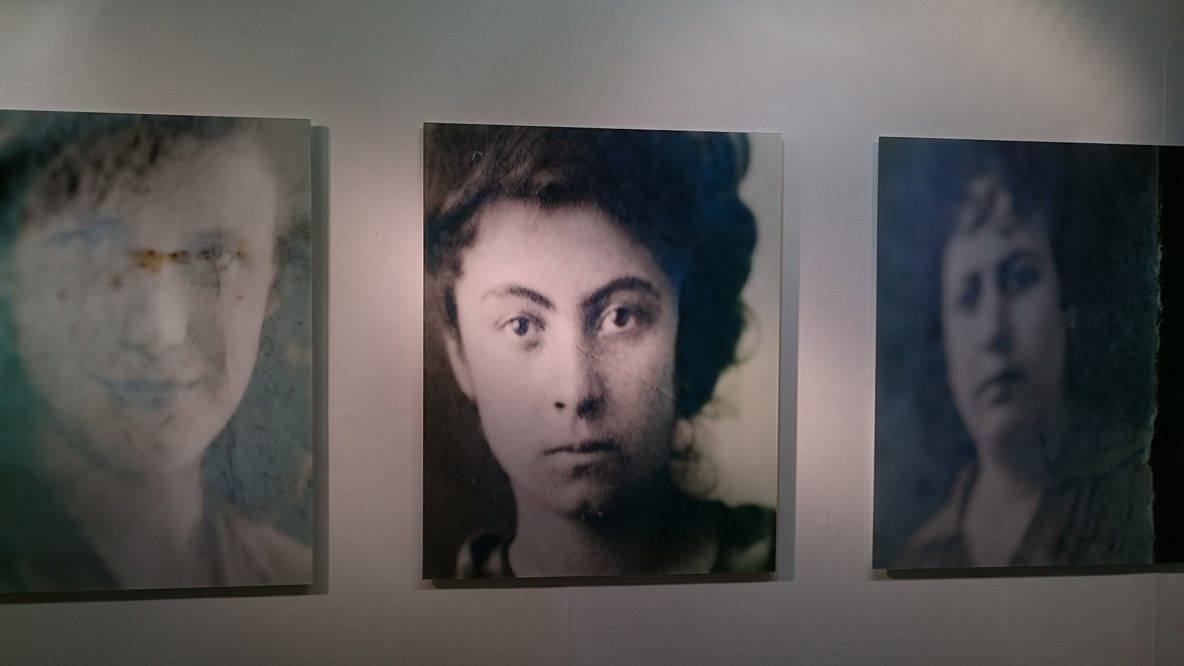
  • Liz-Ann Vincent-Merry: ‘The Marseille Papers’: At first, just a series of aged female portraits, but with some insight into Vincent-Merry’s thought process, it became an attempt to create a ‘dialogue between past and present’, penetrate the 2D photographic surface, and question who they were. One face, central to the collection, was particularly striking, her eyes looking right at you through time.
  • Sian Davey: ‘Martha’: While this piece, as a photograph, did not interest me, the idea behind it opened up a world of speculation. Davey’s daughter features in it, on the cusp of adulthood, and thus neither a girl nor a woman. She becomes someone ‘free of the weight of societal expectations’ and thus not a person at all, a ‘nonentity’. Additionally, she is not identified in the picture which only enhances the enigma and invisibility of ‘Martha’.
    David Gibson
  • David Gibson: ‘Dark Light and Mist’: This small series of misty black and white photographs was perhaps the most introspective of the lot, leaving the viewer feeling almost isolated in the profound quiet of the pieces. Each appears to be filled with fog/mist with just a hint of detail such as a tree, allowing the eyes to sift through the layers and the mind to imagine what lies beneath.

I think I have successfully covered all which piqued my interest for today. All quotes are from the various leaflets provided. With day two over, bring on the third and final day!